The panel “Current trends in corporate governance. ACG Round Table”
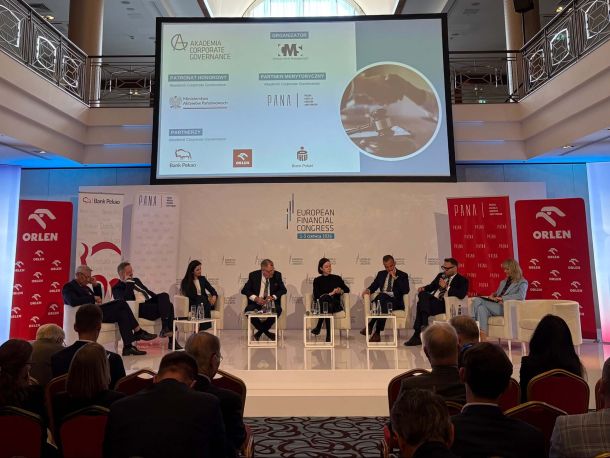
Later in the Congress, Szymon Paweł Moś, Chairman of the Management Board of Polska Spółka Gazownictwa, took part in the panel “Current trends in corporate governance. ACG Round Table”.
The discussion focused on current challenges relating to corporate governance – both from a regulatory perspective and in terms of the practical functioning of companies. The panellists paid particular attention to the importance of the competence of management and supervisory staff, the appropriate selection of members of company bodies, and ensuring their independence.
Another key element of the discussion was the need to apply and develop best practice in the area of corporate governance – both at national and international level.
- As Polska Spółka Gazownictwa, we operate in a unique environment – we are part of the ORLEN Group, whilst at the same time being a regulated undertaking – a distribution system operator – subject to strict supervision by the President of the Energy Regulatory Office. This means we must reconcile two frameworks: corporate governance and regulatory requirements. The separation of powers between the owner and the regulator, resulting from the restrictions imposed by energy legislation, is crucial. In accordance with these provisions, the owner has the right to supervise such a company in terms of return on assets or, for example, to monitor its debt levels. It also adopts an annual business plan, but this must strictly comply with the development plan, approved by the President of the Energy Regulatory Office, who, on the one hand, ensures that funds for capital expenditure are included in the tariff and, on the other, holds PSG to account for its implementation – the CEO pointed out.
- The Chairman of the Energy Regulatory Office (URE) also monitors whether, as a distribution system operator, we operate in an independent, transparent and impartial manner towards all market participants, regardless of ownership structures. The President of the Energy Regulatory Office clearly states that the operator must not favour any entity, even if it operates within the same group – all the more so when, as in the case of PSG, our owner holds a sales licence for gas trading. This applies to access to information and the organisation of cooperation, as well as, for example, the conduct of human resources policy and the performance of audit functions. This results in restrictions on the use of shared solutions across the entire group. At the same time, it is precisely thanks to our presence within the ORLEN Group that we have access to modern solutions, tools and know-how which genuinely strengthen PSG’s position – examples include the implementation of the Connect platform and the development of our contractors’ expertise in the area of local content – the challenge is to utilise these in accordance with the requirements of the so-called compliance programme and energy law,” he added.
- I would also like to point out that PSG is a significant part of the ORLEN Group – it accounts for 65 per cent of net profit, 18 per cent of EBITDA and represents 18 per cent of the Group’s total workforce. It is worth emphasising here that over 99 per cent of our revenue comes from tariffs approved by the Energy Regulatory Office (URE). Corporate governance at PSG is not merely a formal set of procedures – it is a fundamental element of risk management and a prerequisite for conducting business,” emphasised the CEO.
The debate was attended by representatives of public administration, supervisory bodies and leading financial companies and institutions.
The PSG Chairman’s participation in the European Financial Congress forms part of the company’s active engagement in the dialogue on corporate governance standards, transparency and responsible business development.
Later in the Congress, Szymon Paweł Moś, Chairman of the Management Board of Polska Spółka Gazownictwa, took part in the panel “Current trends in corporate governance. ACG Round Table”.
The discussion focused on current challenges relating to corporate governance – both from a regulatory perspective and in terms of the practical functioning of companies. The panellists paid particular attention to the importance of the competence of management and supervisory staff, the appropriate selection of members of company bodies, and ensuring their independence.
Another key element of the discussion was the need to apply and develop best practice in the area of corporate governance – both at national and international level.
- As Polska Spółka Gazownictwa, we operate in a unique environment – we are part of the ORLEN Group, whilst at the same time being a regulated undertaking – a distribution system operator – subject to strict supervision by the President of the Energy Regulatory Office. This means we must reconcile two frameworks: corporate governance and regulatory requirements. The separation of powers between the owner and the regulator, resulting from the restrictions imposed by energy legislation, is crucial. In accordance with these provisions, the owner has the right to supervise such a company in terms of return on assets or, for example, to monitor its debt levels. It also adopts an annual business plan, but this must strictly comply with the development plan, approved by the President of the Energy Regulatory Office, who, on the one hand, ensures that funds for capital expenditure are included in the tariff and, on the other, holds PSG to account for its implementation – the CEO pointed out.
- The Chairman of the Energy Regulatory Office (URE) also monitors whether, as a distribution system operator, we operate in an independent, transparent and impartial manner towards all market participants, regardless of ownership structures. The President of the Energy Regulatory Office clearly states that the operator must not favour any entity, even if it operates within the same group – all the more so when, as in the case of PSG, our owner holds a sales licence for gas trading. This applies to access to information and the organisation of cooperation, as well as, for example, the conduct of human resources policy and the performance of audit functions. This results in restrictions on the use of shared solutions across the entire group. At the same time, it is precisely thanks to our presence within the ORLEN Group that we have access to modern solutions, tools and know-how which genuinely strengthen PSG’s position – examples include the implementation of the Connect platform and the development of our contractors’ expertise in the area of local content – the challenge is to utilise these in accordance with the requirements of the so-called compliance programme and energy law,” he added.
- I would also like to point out that PSG is a significant part of the ORLEN Group – it accounts for 65 per cent of net profit, 18 per cent of EBITDA and represents 18 per cent of the Group’s total workforce. It is worth emphasising here that over 99 per cent of our revenue comes from tariffs approved by the Energy Regulatory Office (URE). Corporate governance at PSG is not merely a formal set of procedures – it is a fundamental element of risk management and a prerequisite for conducting business,” emphasised the CEO.
The debate was attended by representatives of public administration, supervisory bodies and leading financial companies and institutions.
The PSG Chairman’s participation in the European Financial Congress forms part of the company’s active engagement in the dialogue on corporate governance standards, transparency and responsible business development.