Sensational discovery at the gas pipeline construction site near Inowrocław
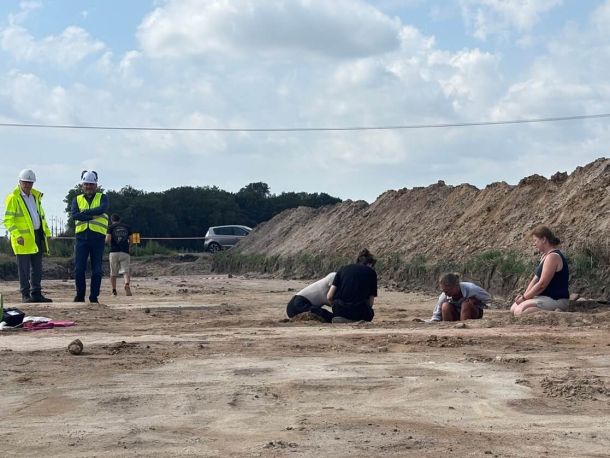
Before the long weekend, during the carrying out of earthworks for the construction of the new PSG gas pipeline from Latkowo to Wrzosy, a unique discovery was made in Orłów near Inowrocław – a mass burial from the Mesolithic period, dating probably to around 8000-7000 BCE. As a result of archaeological works, very well-preserved skeletons of four people were found: of a man, two women, and a child. The discovery made in Orłów is an event of international importance.
A microlith core, characteristic of the late Mesolithic, was found next to the child’s head. According to experts, the mass character of the burial, the lack of pottery, the lack of a Neolithic inventory, and the lack of black soil in the burial pit itself indicate that we are dealing with an exceptionally rare funerary complex from the Stone Age.
Why is it unique in Europe? Because the mass burial is preserved in full, and it is clearly intentional. The arrangement of the bodies is telling – the dead embrace one another, their heads are turned towards each other, and the child is lying between the adults. Our knowledge about Mesolithic beliefs is very fragmentary. The buried from that period were often placed in a contracted position, and the dead were sprinkled with ochre – a symbol of life and blood. Traces of ochre are also visible on the skeletons from Orłów.
The finding comes from the prehistoric era. The Mesolithic is a transitional Stone Age period (around 9500-5500 BCE in Poland) between the Palaeolithic and the Neolithic. The period is characterised by the transition from the hunter-gatherer economy to a very primitive agricultural economy. It was a period of big environmental changes – the global warming following the last glaciation led to the development of dense forests, lakes, and marshes. Contemporary people had to work out new ways of living in that kind of environment.

 Menu
Close
Menu
Close